
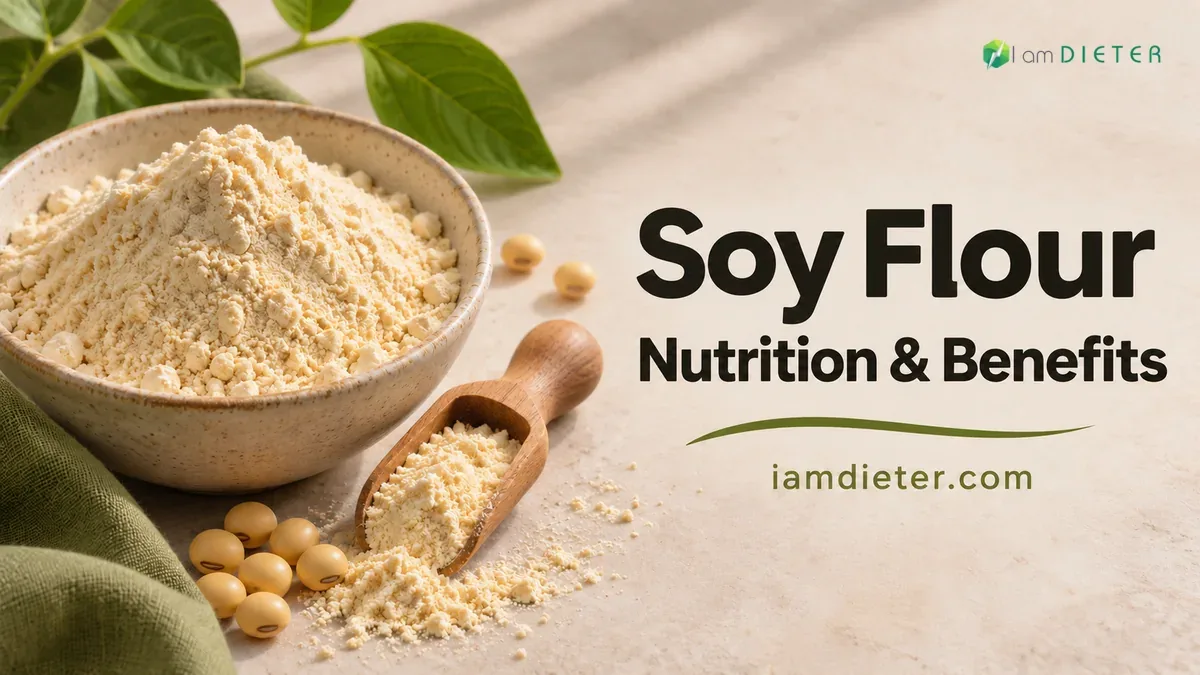
Soy flour is made from ground soybeans and is used in baked goods and other recipes to increase their protein content. Its nutritional composition depends on how much of the soybean oil remains after processing. Per 100 g, raw full-fat flour supplies 434 calories, compared with 372 calories for low-fat flour and 327 calories for defatted flour.
Concerns that eating soy raises oestrogen levels in men are not supported by pooled results from clinical studies. Pure soybean flour is naturally gluten-free, but whether a packaged product is suitable for people with coeliac disease depends on its ingredients and whether it has come into contact with gluten during processing or preparation.
Soy flour calories and nutrition facts
The table compares three types of flour before preparation or the addition of other ingredients. Values are per 100 g and come from USDA FoodData Central's SR Legacy reference records, as reproduced in sources 1–3 below. They are not the nutrition labels for a particular brand sold in Saudi Arabia or Kuwait.
| Nutrient per 100 g | Full-fat (raw) | Low-fat | Defatted |
|---|---|---|---|
| Calories (kcal) | 434 | 372 | 327 |
| Protein (g) | 37.81 | 49.81 | 51.46 |
| Total carbohydrate (g) | 31.92 | 30.63 | 33.92 |
| Dietary fibre (g) | 9.6 | 16 | 17.5 |
| Fat (g) | 20.65 | 8.9 | 1.22 |
| Sodium (mg) | 13 | 9 | 20 |
| Calcium (mg) | 206 | 285 | 241 |
| Potassium (mg) | 2515 | 2090 | 2384 |
| Iron (mg) | 6.37 | 8.2 | 9.24 |
| Phosphorus (mg) | 494 | 675 | 674 |
| Folate (µg) | 345 | 289 | 305 |
Dietary fibre is included in total carbohydrate in these reference records. Defatted flour is not necessarily entirely free of fat or sodium. Protein and fat content can vary from one product to another depending on processing and milling. If your product has a nutrition label, use the figures on that specific package.
How many calories are in a quarter cup of defatted flour?
The reference record lists a cup of defatted flour as weighing 105 g. On that basis, a quarter cup weighs 26.25 g. This is not a universal volume-to-weight conversion, since the actual weight depends on how the cup is filled. A kitchen scale is more reliable.
To calculate the amount of a nutrient in a weighed portion, multiply its value per 100 g by the portion weight in grams, then divide by 100 g. For example: 327 kcal × 26.25 g ÷ 100 g = 85.84 kcal, or approximately 86 calories.
- Protein: approximately 13.51 g.
- Carbohydrate: approximately 8.90 g, including 4.59 g of dietary fibre.
- Fat: approximately 0.32 g.
- Potassium: approximately 626 mg.
- Calcium: approximately 63 mg.
- Phosphorus: approximately 177 mg.
- Folate: approximately 80 µg.
These are calculated values based on the defatted flour reference record (sources 3 and 4), not measurements of every brand. When adding the flour to a recipe, include the nutritional values of the other ingredients and divide the total by the actual number of servings.
Types of soybean flour and how they differ
- Full-fat: retains most of the natural soybean oil. Among the three reference entries it has the highest fat and energy content.
- Low-fat: contains less oil and, in the reference data, more protein per 100 g than the full-fat variety.
- Defatted: most of the oil is removed during processing. This increases the proportion of protein by weight and reduces energy content compared with full-fat flour.
Flour is also different from soy protein isolate. The latter is processed to concentrate protein, whereas flour generally retains more of the bean's other components, including fibre. Nutrition figures for a protein powder cannot simply be applied to flour because both are made from soybeans.
Nutritional benefits of soy flour
Plant protein, fibre and minerals
Soy flour provides plant-based protein as well as fibre and minerals such as iron, potassium and calcium. Protein contributes to the maintenance and repair of body tissues, while dietary fibre supports digestive function. However, no single flour supplies every nutrient a person needs. Dietary variety and the amount used in a recipe matter too.
Does soy affect cholesterol?
A 2019 meta-analysis included data from 43 trials and found that soy protein, compared with non-soy proteins, reduced LDL cholesterol by an average of 4.76 mg/dL. The median follow-up was six weeks, and the median soy protein intake was 25 g per day. This was a modest effect on a laboratory marker, not evidence that a particular amount of flour prevents cardiovascular disease or replaces treatment (source 5).
Does soy flour raise oestrogen levels in men?
Soybeans contain compounds called isoflavones. They are sometimes referred to as phytoestrogens because they can interact with oestrogen receptors, but they are not the same as human oestrogen.
A 2021 meta-analysis of 41 clinical studies in adult men found no statistically significant impact of soy protein or isoflavone intake on total or free testosterone, estradiol or estrone. Subgroup analyses by dose and study duration likewise showed no significant effect (source 6).
These findings do not support general claims that soy foods raise oestrogen to eight times normal levels or cause breast enlargement or impaired fertility in men. They also do not establish that every dose of concentrated supplements is safe for every individual, or rule out all possible effects on every health outcome. Anyone experiencing unusual hormonal symptoms should seek medical assessment rather than assuming soy is the cause.
Soy and women's health during menopause
Some research on soy protein and isoflavone supplements suggests that they may modestly reduce the frequency or severity of hot flushes in some women, although findings are inconsistent. These studies cannot establish that a specific amount of flour treats hot flushes, night sweats or mood changes (source 7).
Similarly, the use of soy-derived compounds in topical skincare products does not establish that eating flour lightens the skin or increases collagen production. Topical preparations are not equivalent to food. Flour should not be relied upon as a treatment for skin conditions or menopausal symptoms.
Can soy foods prevent cancer?
The American Cancer Society considers soy foods generally safe as part of a balanced diet. Human research has associated soy food consumption with a lower risk of certain cancers or no change in risk. However, an association does not prove that soy flour prevents breast, prostate or colorectal cancer. Soy isoflavone supplements are not recommended for cancer prevention (source 8).
Is soy flour gluten-free and suitable for coeliac disease?
Soybeans are legumes and naturally do not contain the gluten found in wheat, barley and rye. However, the flour may come into contact with gluten-containing ingredients in shared mills, production lines or kitchens (source 9).
People with coeliac disease should choose a product with a reliable gluten-free declaration, check its ingredient list and allergen information, and avoid mixing it with wheat flour or using equipment contaminated with gluten. If you suspect that you have coeliac disease, do not begin a gluten-free diet before diagnostic testing unless your doctor advises you to do so.
Risks and precautions
Soy allergy is different from coeliac disease. If you have a soy allergy, the absence of gluten does not make this flour suitable for you. Soy products can also cause digestive symptoms, including bloating and gas, in some people (source 7). Do not replace prescribed medicines or medical treatment with flour or soy supplements.
Using and storing soybean flour
The flour can be added to biscuit, cake, pancake and bread mixtures. However, it does not form the gluten network that gives wheat dough its elasticity, so replacing wheat flour entirely on a one-to-one basis may change the texture and baking result. Follow a recipe designed for the specific flour and its package cooking instructions rather than consuming raw flour.
Keep it in a tightly sealed container away from heat and moisture, following the manufacturer's directions. Full-fat flour may require extra care because its natural oils can oxidise during storage. Follow the expiry date and storage conditions printed on the package instead of assuming the same shelf life for every type.
Frequently asked questions
Is defatted flour completely fat-free?
Is soy flour the same as soy protein isolate?
Can I prepare a gluten-free recipe using it?
Related reading
- Soy protein (Arabic)
- Soybean oil (Arabic)
- Green soybean nutrition (Arabic)
- Alpro soy milk calories (Arabic)
- Read the original article in Arabic
Note: This information is for general educational purposes and does not constitute medical advice.
Sources
- USDA SR Legacy — FDC 174273 (displayed by WhatYouEat): reference values for raw full-fat flour.
- USDA SR Legacy — FDC 172444 (displayed by NutriDB): reference values for low-fat flour.
- USDA SR Legacy — FDC 174275 (displayed by NutriDB): reference values for defatted flour.
- FDC 174275 (displayed by GetFoodFacts): reference cup weight of 105 g.
- Blanco Mejia et al., 2019, The Journal of Nutrition: meta-analysis of soy protein and cholesterol.
- Reed et al., 2021, Reproductive Toxicology: meta-analysis of reproductive hormone levels in adult men.
- National Center for Complementary and Integrative Health (NCCIH): evidence on soy, safety and menopausal hot flushes.
- American Cancer Society, 2025: soy foods, cancer risk and the distinction between food and supplements.
- National Institute of Diabetes and Digestive and Kidney Diseases (NIDDK): gluten-free diets, cross-contact and flour options.