
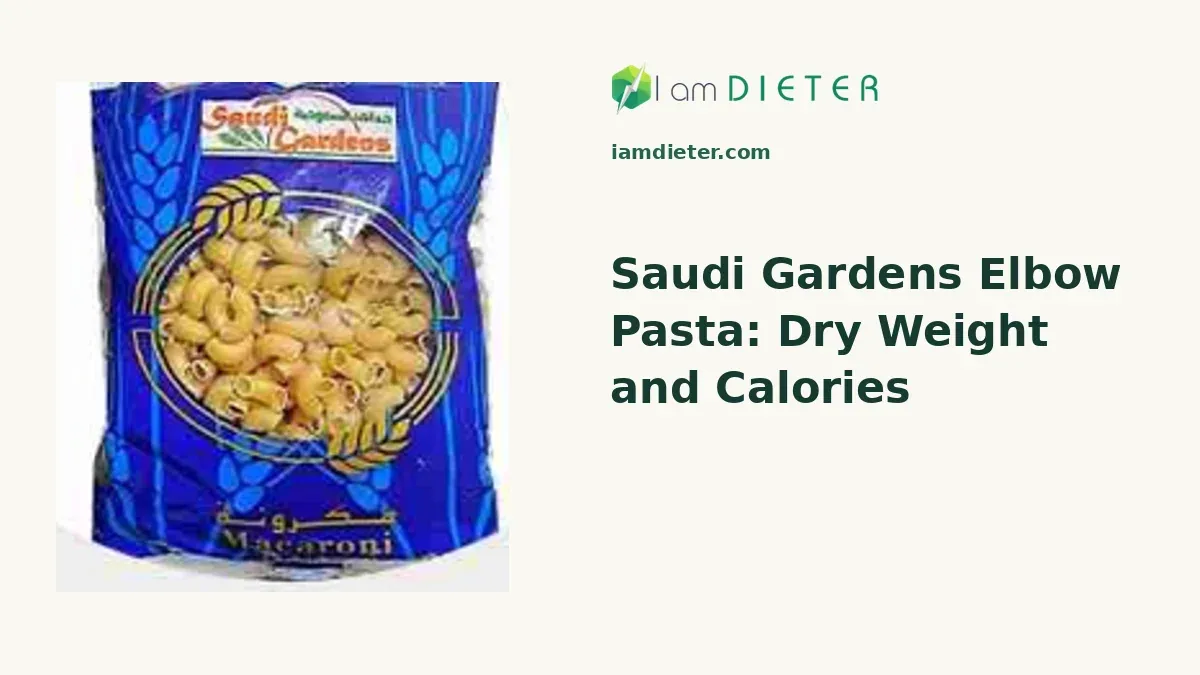
The earlier Saudi Gardens elbow pasta record gives 327.3 kcal for 100 g. The previous preparation instructions describe dry pasta before boiling; the figures are therefore presented on a dry basis, although the current label has not been confirmed. A 100 g cooked portion is not equivalent to 100 g dry pasta.
Saudi Gardens elbow pasta nutrition
| Nutrient | 100 g dry (recorded) | 50 g dry (calculated) |
|---|---|---|
| Energy (kcal) | 327.3 | 163.65 |
| Fat (g) | Less than 0.1 | Less than 0.05 |
| Saturated fat (g) | Less than 0.1 | Less than 0.05 |
| Trans fat (g) | Less than 0.1 | Less than 0.05 |
| Cholesterol (mg) | Less than 3 | Less than 1.5 |
| Sodium (mg) | 2 | 1 |
| Carbohydrate (g) | 71 | 35.5 |
| Fibre (g) | 5 | 2.5 |
| Sugars (g) | 1.5 | 0.75 |
| Protein (g) | 10.6 | 5.3 |
| Iron (mg) | 3.7 | 1.85 |
| Calcium (mg) | 17 | 8.5 |
Source: the earlier I Am Dieter record. The inequality sign appeared reversed in the right-to-left text; the likely reading is “less than”, not zero. The bounds are retained pending confirmation of the original label. The 50 g column scales the bounds by 0.5. A Kuwait-specific version was not verified.
Dry weight versus cooked weight
For 50 g dry pasta, 327.3 × 50 ÷ 100 = 163.65 kcal. Pasta absorbs water while boiling, so per 100 g cooked values require the final cooked weight. If you weigh the cooked batch, allocate the total dry pasta's energy in proportion to each portion of the final weight. Record cheese, sauce and added olive oil separately.
Ingredients and preparation
The recorded ingredient is durum wheat flour. It contains wheat and is not gluten-free. Earlier instructions called for bringing a litre of water with salt and a teaspoon of olive oil to a boil, adding 100 g dry pasta, cooking for 8–12 minutes and draining. Follow your current package and account for the actual sauce and oil used. Store in a cool, dry place away from sunlight.
Sources
Earlier I Am Dieter article — recorded nutrition, ingredients and preparation. A current matching label was not available to verify the inequality symbols.
Notice: This information is for general education and is not medical advice.