
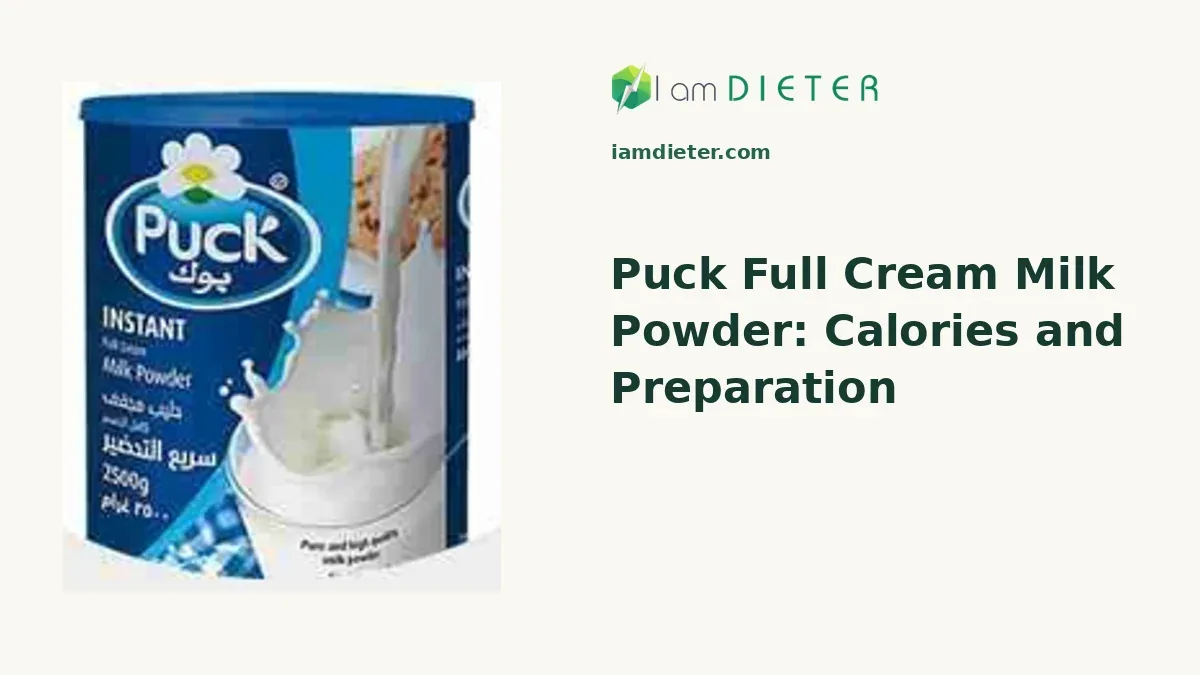
According to the previously recorded data, 32 g of Puck full cream milk powder provides 159.8 kcal. Mixing that powder with 220 ml water, as described in the older preparation instructions, does not add energy. However, the final volume of prepared milk is not necessarily 220 ml.
Puck milk powder nutrition
| Nutrient | 32 g powder (recorded) | 100 g powder (calculated) |
|---|---|---|
| Energy (kcal) | 159.8 | 499.38 |
| Fat (g) | 9 | 28.13 |
| Carbohydrate (g) | 13 | 40.63 |
| Protein (g) | 7 | 21.88 |
Source: the earlier article and Calorie Zone's 32 g record. These are not independent confirmation of the current label. Sugar, sodium and saturated fat are not reported as zero without label confirmation. Puck's official product page lists a 900 g pack but the available text did not give matching numeric nutrition. Kuwait-specific values have not been verified.
Preparing a cup
The earlier directions give 32 g powder (about three heaped tablespoons) mixed into 220 ml previously boiled water, warm or cold, and stirred until dissolved. Calorie Zone describes a 240 ml cup, but this volume should not be used to calculate per 100 ml without matching preparation instructions. Follow the current package.
Calculating nutrition per 100 g
159.8 kcal × 100 ÷ 32 = 499.375 kcal, or about 499.38 kcal per 100 g of powder. The same factor applies to the macronutrients. For the prepared milk, the final measured volume after dissolving the powder is needed before calculating per 100 ml.
Ingredients and allergens
The historical ingredient list includes full cream milk and soya lecithin. The previous article also listed vitamin A at 640 IU and vitamin D at 130 IU, without confirming the original reference amount; these should not be interpreted as covering pregnancy or breastfeeding requirements. Check the current label for milk and soya allergens and lactose. It is not a substitute for infant formula.
Store sealed in a cool, dry place. The earlier directions mentioned three weeks after opening, but follow the current label and expiry date.
Sources
- Earlier I Am Dieter record — serving energy, preparation and ingredients.
- Calorie Zone — recorded macronutrients.
- Puck — product and storage.
Notice: This information is for general education and is not medical advice.