
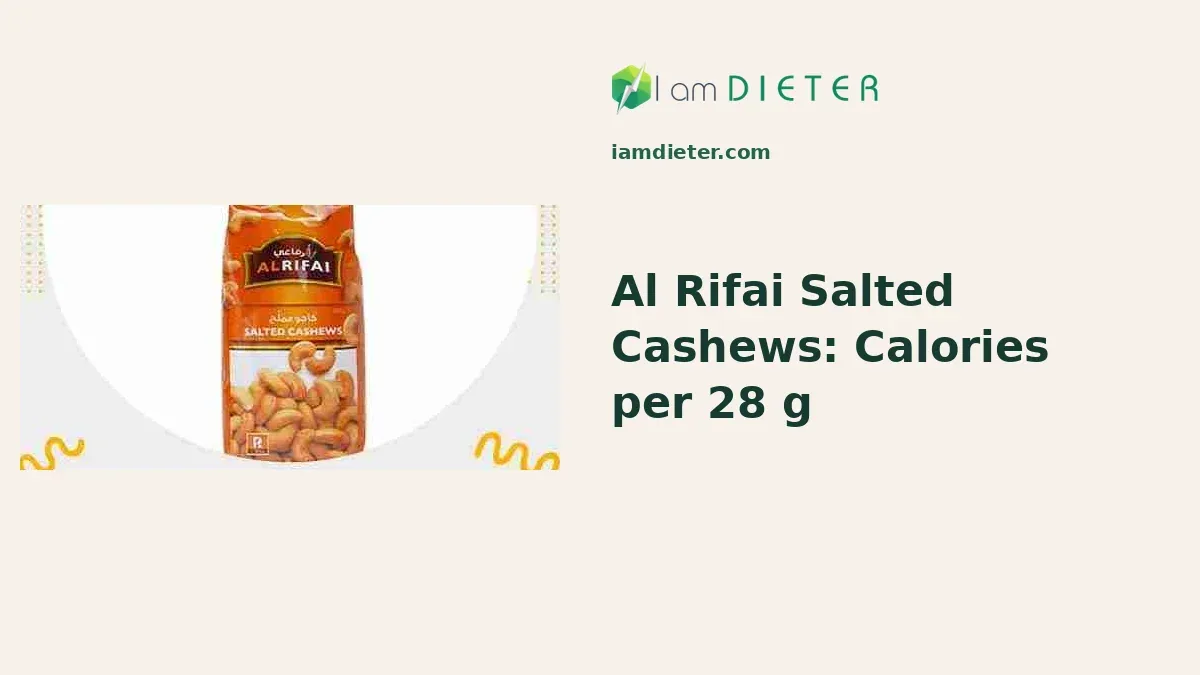
The previously documented 28 g serving provides 173.4 kcal. This applies to the specific flavour and serving on the earlier product label, not every pack sold today.
Nutrition per 28 g and 100 g
| Nutrient | 28 g | 100 g (calculated) |
|---|---|---|
| Energy (kcal) | 173.4 | 619.29 |
| Fat (g) | 13.4 | 47.86 |
| Saturated fat (g) | 2.37 | 8.46 |
| Trans fat (g) | 0 | 0 |
| Cholesterol (mg) | 0 | 0 |
| Sodium (mg) | 86 | 307.14 |
| Carbohydrates (g) | 8.5 | 30.36 |
| Fibre (g) | 1 | 3.57 |
| Sugars (g) | 1.4 | 5 |
| Added sugars (g) | 0 | 0 |
| Protein (g) | 4.7 | 16.79 |
Source: nutrition figures retained from the earlier I Am Dieter article. Current matching Saudi and Kuwaiti labels have not been independently verified; missing values are not zero. The 100 g column is calculated, not a new label measurement.
Serving size and calculation
To calculate energy for a weighed portion, multiply 173.4 kcal by the portion weight in grams and divide by 28 g. For 100 g: 173.4 × 100 ÷ 28 = 619.29 kcal. Check your own pack's serving and net weight first.
Ingredients and allergens
Cashews, soybean oil and salt.
The serving also listed 2.4 g polyunsaturated fat, 7.3 g monounsaturated fat, potassium 177 mg, vitamin C 0.1 mg, calcium 12 mg, iron 1.7 mg and vitamin E 0.26 mg. May contain traces of peanuts and other tree nuts; whole nuts are a choking hazard for young children.
Sources
Earlier Arabic label transcription on I Am Dieter (related product reference); the earlier article's own figures remain historical.
For general education only, not medical advice. Disclaimer.